


shell
benducket3211@gmail.com
Is a 3D Microscope the Future of Advanced Visualization and Precision Imaging? (9 อ่าน)
18 มิ.ย. 2569 22:57
A 3D Microscope is an advanced imaging instrument designed to provide three-dimensional visualization of microscopic objects, offering depth, clarity, and spatial accuracy far beyond traditional 2D microscopes. It is widely used in scientific research, electronics inspection, medical studies, and industrial quality control where precision and detailed surface analysis are essential. Unlike conventional microscopes that show flat images, a 3D microscope allows users to observe height, depth, and surface texture in a realistic and interactive way.
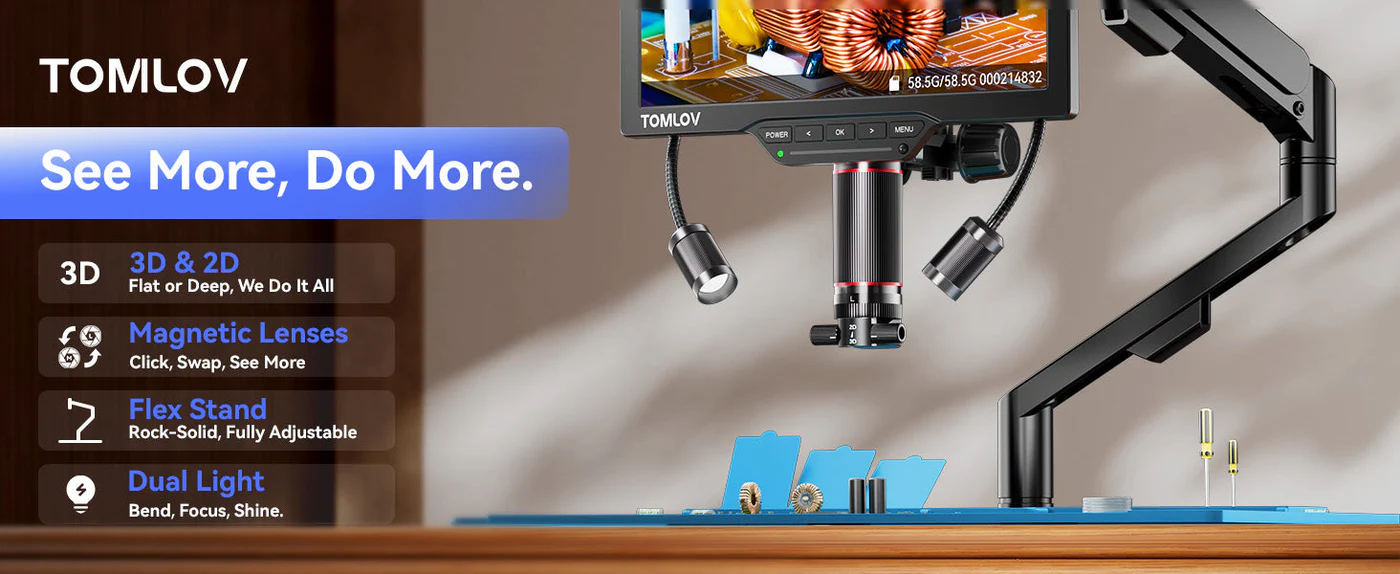
With rapid technological advancements, 3D microscopy has become a powerful tool for engineers, researchers, and laboratory professionals. It enhances understanding of complex structures by providing accurate depth perception and high-resolution imaging. From microchip inspection to biological research, the 3D microscope is transforming how microscopic worlds are analyzed and interpreted.
3D Microscope Imaging Technology
A 3D Microscope uses advanced optical systems, digital sensors, and image processing technology to generate three-dimensional views of microscopic samples. Instead of capturing a flat image, it creates a detailed representation of an object’s surface structure, allowing users to examine depth variations and fine details more effectively.
Many modern 3D microscopes utilize techniques such as stereo imaging, digital stacking, and confocal scanning to build accurate 3D models. These systems capture multiple images from different angles and combine them into a single three-dimensional view. This enables researchers to analyze surface textures, microstructures, and geometric patterns with exceptional clarity.
High-resolution sensors and advanced software further enhance image quality, making 3D microscopy a critical tool in modern scientific and industrial applications.
Scientific Research Applications
A 3D Microscope plays a vital role in scientific research, especially in fields such as biology, materials science, and nanotechnology. In biological studies, it helps researchers examine cell structures, tissue samples, and microorganisms in three dimensions, providing deeper insights into biological processes.
In materials science, 3D microscopy is used to study surface morphology, grain structures, and material defects. Researchers can analyze how materials behave under different conditions by observing their microscopic structures in detail.
Nanotechnology research also benefits significantly from 3D microscopy, as it allows scientists to visualize and manipulate structures at the nanometer scale. This level of precision is essential for developing advanced materials, electronic components, and biomedical devices.
Industrial Inspection and Quality Control
In industrial environments, a 3D Microscope is widely used for inspection and quality control processes. Electronics manufacturers rely on it to examine printed circuit boards, semiconductor components, and microchips for defects or manufacturing errors.
The ability to view components in three dimensions helps engineers identify surface irregularities, soldering issues, and alignment problems with high accuracy. This ensures that electronic devices meet strict quality standards before reaching the market.
In automotive and aerospace industries, 3D microscopes are used to inspect precision-engineered parts, ensuring durability and performance. Even the smallest defect can impact functionality, making detailed inspection essential in high-precision manufacturing environments.
Medical and Biological Imaging
A 3D Microscope is also widely used in the medical field for diagnostic and research purposes. It allows doctors and researchers to examine tissues, cells, and biological samples in a more realistic and detailed manner.
In pathology, 3D imaging helps identify abnormalities in tissue structures, improving diagnostic accuracy. It also plays a crucial role in studying disease progression and developing treatment methods. Medical researchers use 3D microscopes to analyze cellular behavior, drug interactions, and genetic structures.
The ability to visualize biological samples in three dimensions provides a deeper understanding of complex medical conditions and supports advancements in healthcare research.
Digital 3D Microscope Systems
Modern 3D Microscope systems are often integrated with digital technology, allowing users to view, capture, and analyze images on computers or high-resolution screens. These digital systems offer enhanced flexibility and ease of use compared to traditional optical microscopes.
Advanced software tools enable users to measure distances, analyze surface profiles, and create detailed 3D models of microscopic samples. Some systems also support image sharing and data storage, making collaboration easier in research and industrial environments.
Digital 3D microscopes are increasingly used in education as well, helping students understand complex microscopic structures through interactive visualization.
Optical Precision and Depth Perception
One of the most important features of a 3D Microscope is its ability to provide accurate depth perception. Unlike traditional microscopes that produce flat images, 3D systems allow users to observe height variations and spatial relationships between structures.
This depth accuracy is achieved through advanced optical configurations and image reconstruction techniques. Stereo imaging systems use two lenses to simulate human binocular vision, creating a realistic three-dimensional effect. This helps users better understand the physical structure of microscopic objects.
Improved optical precision makes 3D microscopes highly valuable in applications that require detailed surface analysis and accurate measurement.
High-Resolution Imaging Capabilities
A 3D Microscope offers high-resolution imaging that captures even the smallest surface details with remarkable clarity. This is essential for applications such as semiconductor inspection, biological research, and material analysis.
High-resolution sensors combined with powerful magnification systems allow users to observe microscopic features such as surface textures, micro-cracks, and structural variations. The ability to zoom in without losing image quality enhances analytical accuracy and improves decision-making in research and industry.
This level of detail is not achievable with traditional optical microscopes, making 3D microscopy a superior choice for advanced applications.
Educational and Training Uses
A 3D Microscope is also widely used in educational institutions for teaching science and technology subjects. It helps students visualize microscopic structures in three dimensions, making complex concepts easier to understand.
Interactive 3D imaging enhances learning experiences by allowing students to explore biological cells, minerals, and materials in detail. This hands-on approach improves engagement and comprehension in science education.
Training programs in medical and engineering fields also use 3D microscopes to provide practical experience in microscopic analysis and inspection techniques.
Choosing the Right 3D Microscope
Selecting the right 3D Microscope depends on the intended application and level of precision required. Basic models are suitable for educational use, while advanced systems are designed for research laboratories and industrial inspection.
Factors such as resolution quality, magnification range, imaging technology, and software capabilities should be considered when choosing a microscope. High-end models offer advanced features such as real-time 3D rendering, digital measurement tools, and image processing software.
Investing in a high-quality 3D microscope ensures accurate results, better visualization, and long-term reliability.
Conclusion
A 3D Microscope represents a significant advancement in microscopic imaging technology, offering detailed three-dimensional visualization that enhances understanding across scientific, industrial, and medical fields. Its ability to provide depth, precision, and high-resolution imaging makes it an essential tool for modern research and inspection tasks.
From analyzing biological samples to inspecting electronic components and studying advanced materials, the 3D microscope continues to revolutionize how microscopic worlds are explored. As technology advances further, it will play an even greater role in education, research, and industry, making it a valuable investment for professionals seeking accuracy and innovation in microscopic analysis.
43.242.176.44
shell
ผู้เยี่ยมชม
benducket3211@gmail.com
williamson
rodneymullenhere@gmail.com
19 มิ.ย. 2569 05:50 #1
3d microscope are the best quality of device in which you watch every thing in more detail and make it easily to understand the structure of anything in 3d view.
Car Detailing Service in Fresno CA
58.27.243.6
williamson
ผู้เยี่ยมชม
rodneymullenhere@gmail.com